Forex for beginners can be learned in one structured session that covers market mechanics, tools and risk before your first live trade
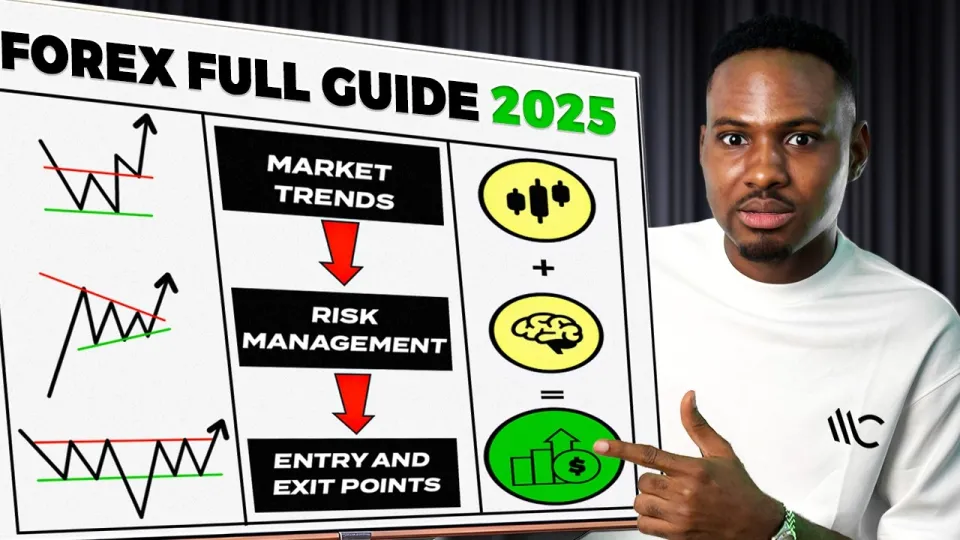
Video: How To Start Forex Trading For Beginners’ 2025 (Full Course)
You can order the same kind of articles for your own video to boost it on YouTube and Google. Just message the Telegram bot @sat_sit_bot. The bot writes and publishes the articles itself (with your YouTube video embedded) on popular topical websites (no ads). Free trial — 50 articles.
· based on the channel Jeffrey Benson Forex
Forex for beginners is the business of buying one currency while selling another, and it can be learned in a fixed order: understand what the market is, learn how orders and leverage work, pick a broker and platform, define risk per trade, then practise on a demo account before risking real money. This guide follows that order and uses the structure of the full beginner course published by Jeffrey Benson Forex. Traders who want the author's own student programme can find the plans and curriculum details at the FirePipsFX student plans page.
What forex trading actually is and why currencies move
Forex is a decentralised market where currencies are quoted in pairs, and the price of a pair reflects how much of the quote currency one unit of the base currency costs. In EUR/USD, the euro is the base and the US dollar is the quote: a price of 1.0850 means one euro buys 1.0850 dollars. There is no central exchange; trading happens over the counter through a network of banks, brokers and liquidity providers, which is why quotes can differ slightly between platforms.
Four forces do most of the work in moving a pair:
- Interest rates set by central banks such as the Federal Reserve or the European Central Bank. Higher rates tend to attract capital and support a currency.
- Inflation data, because it shapes what central banks do next.
- Employment and growth releases, including non-farm payrolls and GDP prints.
- Risk sentiment, where money flows toward safe-haven currencies like the US dollar, Swiss franc and Japanese yen during stress.
Most retail volume concentrates in a handful of pairs. EUR/USD is the tightest and most liquid, GBP/USD and USD/JPY are active but faster, and commodity pairs such as AUD/USD and USD/CAD react to metals and oil. Beginners usually do best on one or two major pairs, because learning a single pair's rhythm beats spreading attention across twenty charts.
How the forex market works around the clock
The forex market trades 24 hours a day from Monday to Friday, rolling through four sessions — Sydney, Tokyo, London and New York — and the handover between London and New York is the busiest, most liquid window of the day. Volatility is not evenly distributed: the Asian session is often range-bound, London brings the first strong directional moves, and the New York afternoon can thin out before the daily close.
This matters practically because every strategy has a session where it works and sessions where it does not. A breakout approach that performs in the London open can bleed in the quiet hours before Tokyo. Beginners should note the session times in their own time zone, then pick one window they can consistently watch rather than trading whenever a chart is open.
Leverage and margin are the other mechanical facts every beginner needs. A broker might offer leverage of 1:100, meaning a $1,000 account can control a position of $100,000. That amplifies both gains and losses: a 1% move against a fully leveraged position wipes out the entire account. Margin is the collateral locked to hold a trade, and a margin call forces the broker to close positions when equity falls too far. Treat leverage as a tool for capital efficiency, not as extra buying power.
The tools a beginner needs before the first order
A beginner's toolkit is short: a regulated broker account, a trading platform, a charting setup and a journal, and none of them need to cost money at the start. The full course spends a large block of time on this section because most early losses come from tooling mistakes rather than bad analysis.
- Broker. Check regulation, spreads on EUR/USD, commission, minimum deposit, withdrawal terms and whether the broker supports the platform you plan to use. A demo account should be available before any deposit.
- Platform. MetaTrader 5 (MT5) is the common choice: it provides candlestick charts, order types, indicators and a demo mode. Linking a broker account to MT5 is a two-step process — register with the broker, then log into the platform with the credentials the broker issues.
- Charts. Start with candlesticks on two timeframes: a higher one such as the 4-hour or daily for direction, and a lower one such as the 15-minute for entries. Support and resistance, trend lines and a moving average cover most beginner needs.
- Journal. A spreadsheet or notebook recording date, pair, direction, entry, stop, target, result and the reason for the trade. Written notes are the single cheapest improvement a new trader can make.
- Economic calendar. Rate decisions, CPI and payrolls create the spikes that stop out otherwise correct trades; knowing when they land is part of the job.
Building a basic forex strategy foundation
A strategy is a written rule set for when to enter, where to put the stop, where to take profit and how much to risk, and it only counts as a strategy once those four answers are fixed in advance. The course builds this from price action rather than indicator stacking, which is the right emphasis for beginners: fewer inputs mean fewer contradictions.
A simple, testable template looks like this. Mark the obvious support and resistance on the daily chart. Wait for price to reach a level rather than chasing it mid-range. Look for a reaction — a rejection candle, a break and retest — on the lower timeframe. Enter in the direction of the higher-timeframe trend, place the stop beyond the level that would invalidate the idea, and set the target at least 1.5 to 2 times the stop distance. That ratio means a strategy winning only 40–45% of the time can still be profitable.
Risk management belongs inside the strategy, not beside it. A common rule is to risk no more than 1% of account equity per trade: on a $1,000 account that is $10 of risk, which with a 20-pip stop implies a position of roughly 0.05 lots on EUR/USD. Ten consecutive losses at 1% cost about 9.6% of the account; at 10% per trade they cost around 65%. That arithmetic, more than any indicator, decides whether a beginner survives long enough to improve.
Placing a first trade and the mistakes that cost beginners money
A first trade should be placed on a demo account, with the order type, stop-loss and take-profit all set before the button is pressed. In MT5 the sequence is: open a new order window, choose the symbol, set volume in lots, select market or pending execution, enter the stop-loss and take-profit prices, check that the risk in money matches the plan, then confirm. Watching the position in the terminal tab afterwards teaches more than any lecture about how spreads and swaps affect the result.
The recurring beginner mistakes are consistent across accounts:
- Trading without a stop-loss, or moving the stop further away to avoid being wrong.
- Oversizing — using maximum leverage because the position looks certain.
- Revenge trading after a loss, doubling size to win it back.
- Overtrading noisy sessions with no setup, which turns a small edge into a stream of commissions.
- Skipping the demo phase, then learning risk management with real money.
- Strategy hopping every few days, so no method is ever tested over a meaningful sample.
Common beginner questions answered from real viewer experience
Viewers of the course repeatedly raise the same practical doubts: how long it takes to become consistent, whether a small account can work, how to copy trades from a signal channel, and whether risk management can really be learned in a single sitting. The honest answers are unglamorous. Consistency is measured in months of recorded trades, not in days of screen time; a small account mainly limits position size, not learning; copy trading removes the analysis but not the need to understand leverage and drawdown; and one clear explanation of risk is enough to start, provided it is applied on every single trade.
A useful benchmark is a demo period of at least 50–100 logged trades on one pair and one strategy before going live. If the journal shows a positive expectancy with controlled drawdown, move to a small live account; if not, the rules need work, not more capital.
Useful links
- Student plans and the full curriculum: https://firepipsfx.com/plans
- Free daily signal channel referenced in the course: https://t.me/firepipsignals
- Broker registration link used in the walkthrough: https://my.assexmarkets.com/auth/register?partner_code=1699134
- Premium signal group access: https://t.me/jeffreybenzhelpbot
Final takeaway
Forex rewards preparation before prediction: learn the pair mechanics, respect the session clock, keep the toolkit simple and let a written risk limit decide position size on every trade. The full beginner course from Jeffrey Benson Forex follows exactly that arc — market basics, tools, strategy foundation, a first trade and the mistakes to avoid — and it is a sound map for anyone starting from zero. Work through it with a notebook open, then prove the rules on a demo account for a few months before funding anything. When the plan is ready, the next step is choosing a learning path at the FirePipsFX student plans page.
Key takeaways
- Forex is the exchange of one currency for another; EUR/USD is the most traded pair and the usual starting point for beginners.
- The market runs 24 hours on weekdays across four sessions — Sydney, Tokyo, London and New York — with London and New York overlapping as the most liquid window.
- A workable beginner stack is a broker account, MetaTrader 5 for charts and orders, and a trading journal for written notes.
- Risk management comes before strategy: capping risk per trade at roughly 1% of the account keeps a losing streak survivable.
- A first trade should be placed on a demo account, with stop-loss and take-profit set before the order is confirmed.
- Jeffrey Benson Forex structures its full beginner course around market basics, tools, strategy foundation, a first trade and common mistakes.
Source: How To Start Forex Trading For Beginners’ 2025 (Full Course) · Markdown version
Questions & answers
How much money do I need to start forex trading?
Many brokers accept deposits from $10–$100, but the amount matters less than position sizing. With a 1% risk rule, a $500 account risks $5 per trade, which is small but still teaches the process. A demo account costs nothing and should come first.
How long does it take to become profitable in forex?
Most traders need many months of logged trades on one strategy before results become stable. A reasonable path is 50–100 demo trades, then a small live account, with the journal reviewed regularly. Anyone promising fast profits is selling something other than skill.
Can I copy trades instead of learning analysis?
Copy trading and signal channels exist and can be a starting point, but they do not remove risk. You still need to understand lot size, leverage and drawdown, and to check how the signal provider's results are recorded before committing capital.
Is forex trading legal and regulated?
Retail forex trading is legal in most countries, but rules differ: some jurisdictions cap leverage, and regulators such as the FCA, ASIC or CySEC license brokers. Always confirm the broker's regulator and whether it accepts clients from your country before depositing.